Innovative Pathways to Transform Healthcare with FHIR GraphQL in the Digital Age

The landscape of healthcare in the USA is rapidly changing, driven by advancements in technology and a growing demand for more efficient, accessible, and patient-centered care. Digital health, encompassing telehealth, remote monitoring, and electronic health records (EHRs), is at the forefront of this transformation. But how do we make all these systems talk to each other securely and effectively? Enter FHIR GraphQL, a powerful combination that promises to reshape how healthcare data is accessed and used.

Understanding the FHIR Foundation

Imagine a world where every medical record is written in a different language. Sharing information would be a nightmare, right? FHIR, or Fast Healthcare Interoperability Resources, is designed to solve this problem. It’s a standard way of representing and exchanging healthcare information electronically. Think of it as a universal translator for medical data, enabling different systems to communicate seamlessly.

FHIR achieves this by defining a set of “resources,” like patient, observation, medication, and procedure. Each resource has a standardized structure and meaning, making it easy for systems to understand and process the data. FHIR also supports various exchange methods, including RESTful APIs, allowing developers to build applications that can access and update healthcare data easily. This interoperability is crucial for improving care coordination, reducing errors, and empowering patients to take control of their health information.

GraphQL; Taking Data Access to the Next Level

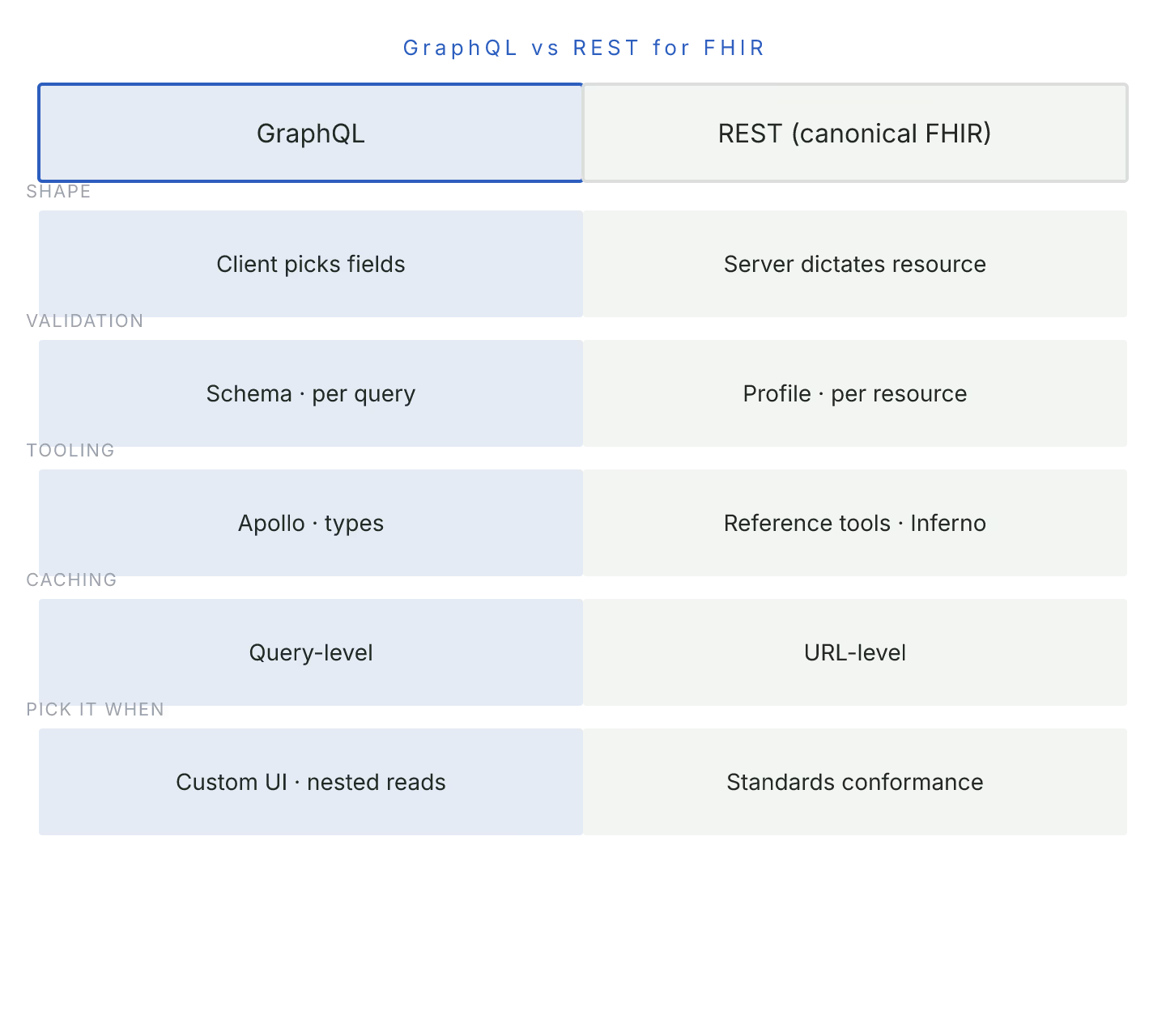
While FHIR provides a standardized way to represent healthcare data, GraphQL offers a more efficient and flexible way to access it. What’s the problem with traditional REST APIs? They often return more data than you need, leading to slower performance and wasted bandwidth. GraphQL addresses this issue by allowing clients to specify exactly what data they need in a single request.

Imagine ordering a pizza. With a traditional REST API, you might get the whole menu, even if you only want a slice of pepperoni. GraphQL, on the other hand, lets you ask for just that slice, nothing more, nothing less. This precision results in faster response times, reduced data transfer costs, and a better user experience. Developers can build more efficient and responsive healthcare applications, improving the quality and speed of patient care.

FHIR GraphQL; A Synergistic Combination

Combining FHIR and GraphQL creates a powerful synergy that can unlock the full potential of healthcare data. FHIR provides the standardized data model, while GraphQL provides the efficient data access layer. Together, they streamline the development of healthcare applications, making them more interoperable, performant, and user-friendly.

How does this work in practice? Let’s say a developer wants to build an app that displays a patient’s recent lab results and medications. With FHIR GraphQL, they can write a single query that retrieves only the necessary data, avoiding the need to make multiple requests to different endpoints. This not only speeds up the development process but also improves the app’s performance, providing a better experience for patients and clinicians. The use of FHIR GraphQL also means developers can adapt more rapidly to changing requirements, iterating quickly on new features.

Applications in Digital Healthcare

The potential applications of FHIR GraphQL in digital healthcare are vast. Telehealth platforms can use it to efficiently retrieve patient data during virtual consultations. Remote monitoring devices can use it to transmit real-time data to EHRs, enabling proactive care management. Patient portals can use it to provide patients with secure and personalized access to their health information.

Consider a scenario where a patient is using a wearable device to track their blood sugar levels. The device can use FHIR GraphQL to transmit this data to the patient’s EHR in real-time. The patient’s doctor can then access this data through a telehealth platform, using FHIR GraphQL to retrieve only the relevant information. This enables the doctor to monitor the patient’s condition remotely and make timely interventions, improving the patient’s health outcomes.

Overcoming Challenges and Looking Ahead

While FHIR GraphQL offers tremendous potential, there are also challenges to overcome. Implementing FHIR can be complex, requiring a deep understanding of the standard and its various resources. GraphQL also has a steeper learning curve than traditional REST APIs. Security is also paramount, as healthcare data is highly sensitive and must be protected from unauthorized access.

Despite these challenges, the future of FHIR GraphQL in healthcare is bright. As more healthcare organizations adopt FHIR and developers become more familiar with GraphQL, we can expect to see a proliferation of innovative healthcare applications that leverage this powerful combination. These applications will empower patients, improve care coordination, and drive down healthcare costs.

The transformation of healthcare with FHIR GraphQL is not just a technological imperative, it’s a moral one. By embracing these innovative approaches, we can create a healthcare system that is more efficient, accessible, and patient-centered, benefiting everyone. Ultimately, the goal is to harness the power of digital technology to improve the health and well-being of individuals and communities across the USA.